HOW IT ALL GOT STARTED

Hello and thanks for visiting my climbing blog!

My name is Scott and I live in Atlanta, GA. I always had an interest in climbing mountains, but never really knew how to get started. In January of 2005, the company I was working for decided to open an office in Memphis and I volunteered to move and help get things kicked off. When I arrived in Memphis I only knew one person, whom I met a few years prior at a wedding, so I gave him a call. He agreed to meet me that evening, but couldn't stay out late because "...he was heading to Africa the next day." Upon meeting him that night, I learned he was leaving the next morning to try his hand at climbing Kilimanjaro.

The next morning, I was talking to my mother and telling her about the conversation from the previous night. During this conversation she asked me if I realized my Uncle Steve had been a climber for years. "No," I responded. She gave me his phone number and the following weekend I made a call to a relative I hadn't spoken to in years. Little did I know how much that call would change my life!

In the 6 years since, I've been to Africa (Tanzania & Kenya), Russia (Moscow & Mineral'Nye Vody), Mexico, Georgia (The country, not the state), and South America (Chile & Argentina), summitted Mt. Kilimanjaro, Mt. Elbrus, and Mt. Rainier, made two attempts at Cerro Aconcagua, an attempt at Ixta, made quick stops in London and Quito, Ecuador, met an endless number of extraordinary people, and developed a new relationship with my uncle.

The blog entries, pictures, and details below are my attempt to share my adventures with the rest of my friends and family. I hope you enjoy!

Wednesday, May 26, 2010

Pictures From Yesterday


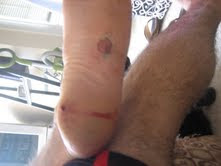
My foot is still swollen quite a bit and the bottom has started to peel - I presume from the beating it took running on the dirt/cement/rocks. Still in a fair amount of pain but I was able to sleep through the night for the first time yesterday. Hopefully the healing process moves along quickly.

Training Setback - The Warrior Dash Mishap

I signed up for the Warrior Dash several months ago - this is an adventure/boot camp style 5K with multiple obstacles (Running across planks over water, jumping over fire, crawling through heavy mud underneath barbed wire, that sort of thing). I figured it would fit in perfectly with my training since the race was 2 months from the climb.

I also thought the race would be pretty uneventful....I thought wrong. The gun goes off and we run on open road for about a half mile until we come to the first obstacle - which is crossing a lake over 12 inch wide planks. On my first step, I slip and fall and my shoe gets stuck in the mud. When I pull my foot out, my shoe is gone! I turn around and dig for it but its nowhere to be found (I still have my sock on at this point). Unable to find the shoe, I decide to continue the race with just one shoe - after all, this is called The Warrior Dash, so there's no way Im quitting!

On the next step, I slip and fall again, this time losing my sock. Now its just my bare foot and the open road! I trudge through the lake and make it back to land and run the next 2 miles with one bare foot and one sneaker on. I pull back up into the top 20 or so, being ultra cautious not to hurt my foot and with some extra adrenaline from the people cheering for me since I continued the race with only one shoe, and I'm putting together a reasonable showing.

Then I come to the 3rd to last obstacle - sliding down a hill into hay bails and then crawling through super thick mud under barbed wire - and as I come down the hill and land over the hail bails.......I feel a rock go through my foot. Immediate pain. I crawl through the mud, veer off to the first aid team, and look down to see a decent amount of blood. After hemming and hawing with the first aid girl for a few minutes, we decide it'll be quicker for her to just wrap my foot, Ill finish the race, and then go to first aid - which I did.

Unfortunately, this led to a 1.5 hour trip to the urgent care facility when I arrived back in Atlanta, 4 shots of Novocain in my foot (The most painful shots Ive ever had), and now the inability to put any weight on my foot. Needless to say, training is now on hold. The doctors think I should be able to put weight back on my foot in 10-12 days and then resume training from there. Ill keep everyone posted, but until then, here are some pictures, pre-doctor, for your viewing enjoyment!

Rainier Training Update

57 days until departure...

Training was going really well through May 22nd. I had gotten my heart rate to top out at 174 and was maintaining 150 quite easily for upwards of 40-45 minutes. To increase my leg strength, I began the process of adding weight to my pack (20 pounds) then climbing the stadium stairs at Oglethorpe for 1 hour. (If you are wondering, its 48 stairs high - I get bored when training and count these sort of things). So, right on schedule.

One of the things I do when I get close to a climb is cut off any activities that could injure my legs (softball, basketball, etc...). Needless to say, I take a lot of crap from my friends for it, but Ive seen too many people get hurt and these trips are too expensive to risk it. Which brings me too my next posting....

Monday, May 10, 2010

Rainier Training Update

73 days until departure...

Training has been in full swing now for over 2 weeks and I've already lost 9 pounds. My heart rate when I'm working out is peaking at 160-165 and I'm holding 150 for about 30 minutes. Ultimately, Ill peak in the 180-190's and be able to hold 160 for about 3 hours. Ive completely changed my training for this climb (More of a focus on building leg strength) and cut down on the long distance running and added in more stair master/stairs. My office is 11 floors and security is letting me use the stair well, so I start in the basement, climb to the top, take the elevator back down to the basement, and repeat for 1-3 hours.

I figure if this new training backfires, Rainier is low enough where I can muscle my way to the top and return to the old training in September that got me to the top of Elbrus and Kilimanjaro. However, if this training is better, Rainier will be very "easy" - or at least as "easy" as climbing a mountain can get. Below are the 3 areas of training:
  1. Cardio - I'm doing heavy cardio about 5 days a week and it consists of a mix between running (3-5 miles per run), the stair master, hiking (8-12 miles per hike), climbing the stairs in my office building, SPIN class, and the Spartacus workout (BTW, if you haven't tried the Spartacus workout, it puts hair on your chest. Fast.)
  2. Strength training - Lifting everyday with the following rotation: Chest on Monday, back on Tuesday, recovery Wednesday, shoulders Thursday, and Bi's/Tri's on Friday. Having strong shoulders and back are imperative for long climbs since you are normally carrying a 30-60 pound backpack. We also have been substituting one of those days each week with the Spartacus workout.
  3. Diet - The diet portion is tricky because you cut out all the crap (beer, soda, sugar) but still have to up your calorie intake since you are burning so many calories during your workouts. I'm eating 6 meals a day which consist of Special K, old fashioned oatmeal, grilled chicken breasts, egg whites, salads, tuna, low fat yogurt, fruit (usually apples or bananas), protein bars, and about a gallon of water per day.
Needless to say, I sleep well at night! Speaking of, off to bed.

SZ

Sunday, May 9, 2010

And the winner is.....

After much research, deliberation, phone calls, and emails, I have made my selection for the Aconcagua trip this January.....(Insert drum roll sound here)....And the winner is:


I really couldn't go wrong with any of the 3 companies, but after all my research, my gut told me to go with IMG. After I talked to people that have climbed with them, I placed calls directly to the guiding companies to answer my final questions. When I called IMG, I talked to a gentleman named Tye and he was more than willing to chat. Our initial phone call lasted 25 minutes - usually if you can get 5-10 minutes you are lucky - and that was followed up by a quick email from one of IMG's Directors the next day providing his personal cell in case I wanted to ask him any additional questions. A very small gesture, but something I saw as important in the competitive world of mountain guiding.

Even though some of my questions were basic, I never got the feel from IMG that I was bothering them. So, this is a major decision out of the way and one Im very happy with. The deposit has been made and I will depart for Argentina exactly 8 months from today!

SZ

Sometimes Life Gets In The Way

After a bit of an absence from the blog to deal with the wedding, it's time to get back down to business. From here on out, Ill probably be posting about once a week, if not more. I'm exactly 2.5 months out from the climb, so training is in full swing, gear checks are starting, the remaining balance for the trip has been paid, and many hours are being spent at the gym.

In addition, for the first time in 4 years I'm putting away away the poker chips on Wednesday nights and hanging up the softball cleats until August to fully focus on training.

SZ

Tuesday, March 2, 2010

The Earthquake in Chile

Ok, Ive stumbled upon 5 free minutes and figured I'd address the questions coming in about the earthquake in Chile. For those that followed the Aconcagua climb last year, you are aware we flew into Santiago, Chile and then on to Mendoza, Argentina - which is the normal flight pattern to reach the mountain. I believe the center of the earthquake was about 200 miles south of Santiago, which means it was probably about 250-300 miles southwest of Aconcagua.

From what Ive been able to read and hear through the guiding companies, there were very few teams on the mountain when this happened since the season is at the tail end. The teams on the mountain did feel the earthquake, and it sounds like they got a pretty good shake, but were not in harms way. In actuality, they were able to continue up the mountain and summit.

The biggest dangers on mountains, at least when you are stationary, are rock slides, falling boulders, and avalanches (Altitude sickness & crevasses would be close behind, but those are more of a problem when you are moving), which brings me to my point. With those 3 things - rock slides, boulders, and avalanches - always being a big problem, a lot of time camps are strategically established on the mountain with those dangers in mind. Now, it is mountain climbing so you are never 100% safe and we'd be naive to think the danger level didn't increase with an earthquake, anytime you are low on a mountain and rocks fall they need somewhere to go, but if you did your homework in the first place you are increasing your chances of safety. Since I have been climbing, I have only heard of 2 instances of people being hit by falling debris while sitting/sleeping in camp (And one of those was a freak accident on Kilimanjaro when hikers were camping in an area they shouldn't have been). In Aconcagua's case, it's a very "dry," rocky mountain, so falling rocks are a bigger issue than avalanches. The reverse could be said on a mountain like Elbrus, which is a heavily glaciated mountain.

From my understanding, the airport in Santiago is still closed so the hikers coming off the mountain will most likely switch their outbound flights to Buenos Aires or another major South American country. For those that summitted, I'm sure they will be OK with this!

In the meantime, my trip is still a "go" and let's all pray Chile recovers quickly because its a beautiful country.

SZ

Friday, February 19, 2010

Fast Fact - From the "Unbelievable" Department

I was just reading online that a guide from Alpine Ascents, Lakpa Gelu, set the record on Aconcagua a couple days ago for the fastest speed climb of the mountain. He climbed from base camp to the summit in 4 hours and 45 minutes!! To put this into perspective, it takes regular climbers 6-8 days to safely do that same climb.

The internal body differences between Khumbu region folks and normal human beings absolutely amazes me. This same guide has also summited Everest 13 times and also held the speed record on Everest for a while - he went from base camp to the summit in 11 hours. Insane.

Saturday, February 13, 2010

And then there were...

Over the last two weeks I have been talking about narrowing my list of companies down to three for the 2011 Aconcagua expedition. I still haven't finished my research, and most likely wont for another 2-3 weeks, because most of the guides aren't back from the 2010 Aconcagua season yet. There remains lingering questions about food, porters, and how medical situations are handled (All areas I had concerns with after the 2009 trip). Most teams will be leaving the mountain towards the end of February - this is when the summer starts to end in the southern hemisphere and the weather once again becomes unstable - so I should be able to get answers by the beginning of March. So, without further adieu, here are my final 3 choices:

Berg Adventures (BA) - The classic 7 Summits company. BA is led by Wally Berg, one of the most accomplished mountaineers alive today, and is the company I used last year. Of the 3 finalists, Berg Adventures is the only company that uses the Horcones Valley route up and down the mountain. This company has several positive factors on their side, which include:
  • Mountaineering Experience - You won't feel any safer on a mountain than you do with Wally Berg. There isn't a situation he hasn't encountered. (I believe he also has 9 summits of Aconcagua).
  • The "2nd Time Around" Factor - There's always a tremendous amount of confidence you gain when doing something a 2nd time. In this case, I know what Wally expects of his climbers, what type of schedule he runs, what each camp consists of, which days will be more difficult than others, what food he provides, and how his porter system works.
  • Two Days Per Camp Acclimatization - BA stays at every camp 2 nights all the way up the mountain. This method always allows you to sleep at the same altitude on consecutive nights for the entire climb.
Alpine Ascents (AA) - Another classic, award winning, 7 Summits company that has been in business for 23 years. Of all the major US guiding companies, AA touts itself as a leader on Aconcagua. They approach base camp via the Vacas Valley on the east side of the mountain, opposite of Berg Adventures, and descend out the Horcones Valley. The factors weighing heavily in AA's favor include:
  • Aconcagua Experience - While the other companies on this list run one, maybe two, Aconcagua trips a year, AA does over 10. Starting in late November, a new trip leaves from Mendoza every week until the end of February. That's typically 10-11 expeditions per season.
  • The 4th Camp - The other two companies on this list use three camps above base camp, AA uses four. Their 4th camp is situated at 20,600 feet - about 1,000 feet above the other companies' Camp 3. This advantage is major on summit day, always the most difficult, and allows you to cut several hours off your summit attempt.
  • Smaller Team Option - Alpine Ascents offers climbs with only 6 climbers. Usually, the smaller the group , the easier it is to move around the mountain. Large groups typically get broken up into 3 sub groups of fast, moderate, and slow paced climbers. A smaller team allows everyone to stick together.
International Mountain Guides (IMG) - The final company, IMG, is another very well-known mountain guiding company who has also been in business for 23 years. IMG, like AA, uses the Vacas Valley on their approach, the Horcones Valley on the descent, but only uses three camps above base camp. Positive attributes for IMG include:
  • Wealth of Experience - Regardless of the mountain, IMG can take you there. From top to bottom, their guides have a tremendous amount of experience. For those that watch the TV show "Everest: Beyond The Limit," one of the gentleman featured on that show, Mike Hamill, leads their Aconcagua expeditions.
  • Excellent References - Nothing is more powerful than one climber telling another about the great experience they had. I had friends climbing with IMG over the last 2 years and they had nothing but rave reviews. The guides, the food, the program, you name it, it all seems as advertised - Top Notch.
There you have it, my final 3 choices for the 2011 Aconcagua expedition! Personally, I don't think I can go wrong with any of the choices, however, it's still fun to go through this process. Who knows, maybe someone from these companies will read this blog, contact me, and tell me why I should use THEM!

OK, for now it's time to shift gears and begin focusing on Rainier (Only 5 months away). Ill post the Rainier itinerary and some more information on the trip in the next few days.

Until then...

SZ

Monday, February 8, 2010

Selecting a Guiding Company

As you get closer to a climb, one of the most important decisions you have to make is what guiding company you will choose to lead you to the top of a mountain. It's not really a complicated process, however, like with other things in life, you have several options to chose from and, typically, you get what you pay for. I feel the best way to do it is by determining 3-5 factors that are the most important to you and then going from there.

We are now 11 months out from the climb and most companies have started to post their 2011 Aconcagua schedules, so its never too early to get that deposit down. Once you have selected your company, its just a matter of topping off your gear list, training, and booking your flight.

Most major guiding companies are more expensive than the smaller operations, but you normally get better guides, better food, more safety precautions, and a US-based company - always important in case something goes wrong. I will be looking at the guiding companies a little differently than I did last year now that I have experience on the mountain and know what items I want to change. In addition, I have several friends that were on the mountain this year with different companies and Ive started to question them on their trips to get a better idea of how things were done. Then, after finishing those conversations, Ill personally call each company I'm considering and speak directly with a guide (One of those "gut feeling" things). Here are some of the major factors that someone would use when selecting a guiding company for Aconcagua:
  • What route do they take up the mountain?
  • How many days to they take to acclimatize before attempting to summit?
  • How long do they spend at each camp?
  • How many camps do they establish above base camp?
  • What type of food regiment do they provide?
  • Are they priced fairly when compared with other companies?
  • Do they use porters at all?
  • Are the rest days spread out appropriately?
  • How many people are on each team?
  • How many professional guides will be with the team?
  • What do the guides' climbing resumes look like?
  • What "surprise" costs might there be?
  • What is/isn't included in the cost?
  • Have you climbed with this company before?
  • What feedback have you received in the climbing community about a company?
For the most part, none of these items really has a right or wrong answer, it's just a matter of personal preference. As you go on more and more expeditions, you will climb with big/small groups, inexpensive/expensive companies, use/not use porters, move too fast/too slow, have good/bad guides, etc... Its all a learning process. Ideally, you'd like to find one guiding company and stick with them so they become familiar with your tendencies on a mountain - specifically, how your body reacts to altitude. Unfortunately, not all companies go to all mountains so this is virtually impossible.

So, this is where I'm at right now in the selection process - trying to evaluate which of the items above are the most important to me. I have narrowed my choice down to 3 companies and Ill announce those by the weekend, along with posting all the details on the July Rainier trip.

SZ